
Well Pump Replacement in Powhatan, VA: Submersible & Jet Pumps
If the pump on your Powhatan County well has worn out, or you've been told it isn't worth fixing again, the next questions are what kind of pump goes back in, what size, and what it costs. This page explains submersible and jet pumps, how a replacement is matched to your well and tank, what the job involves, the constant-pressure option, the Virginia rules (a pump swap needs no VDH permit), and published prices.
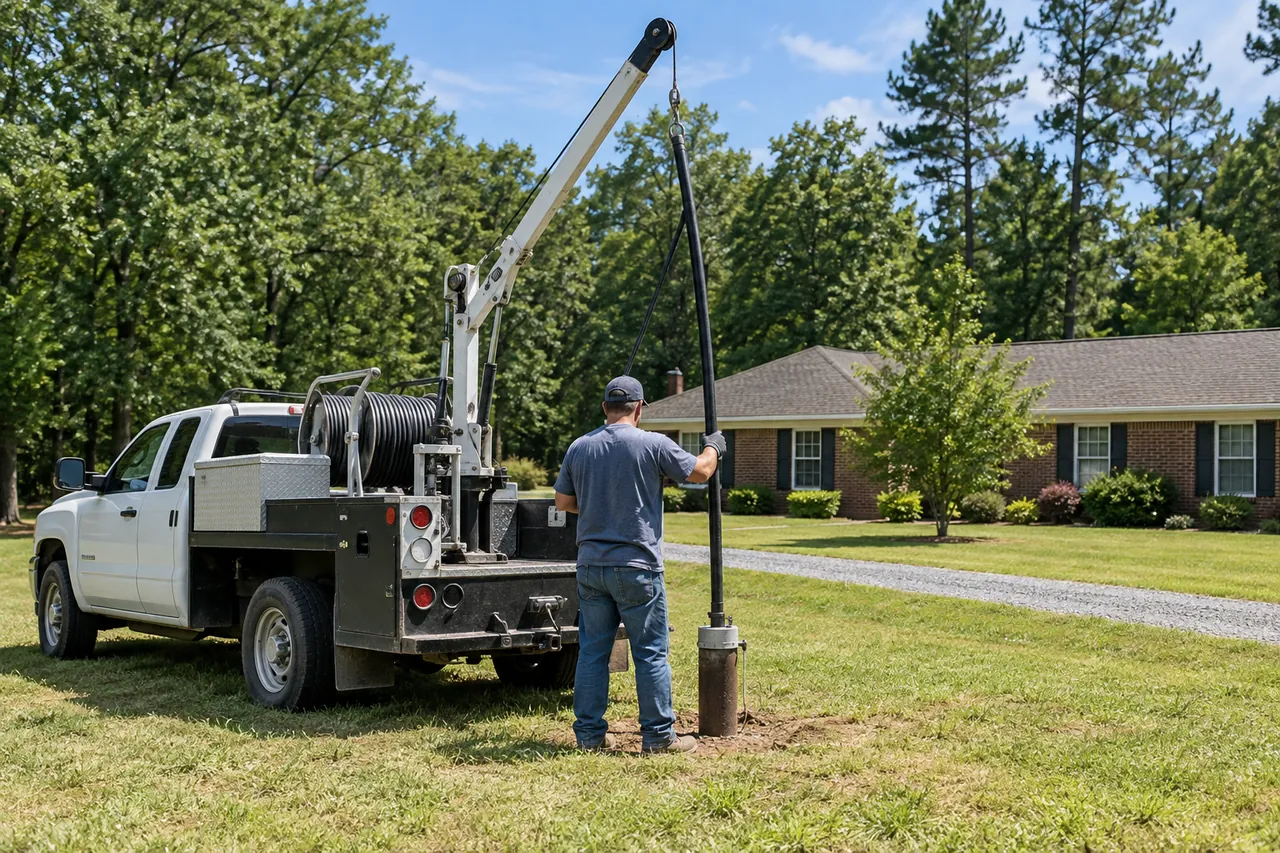
Submersible or jet: which one do you have?
Look at what's above ground. Jet pumps always sit above ground, so if there's a pump and motor in your basement, crawlspace or well house, piped to the well, you have a jet pump. If all you find is a pressure tank, a pressure switch and maybe a control box, with the well casing sticking up in the yard, the pump is down in the well, and that's a submersible. University of Nebraska–Lincoln Extension's well system guide (G2152) describes the three types:
- Submersible. Pump and motor combined, roughly 3½ inches in diameter and 2 to 3 feet in length, set below the water level. It needs a casing at least 4 inches in diameter, though some models fit 3-inch wells. Sitting below the frost line, it needs no frost protection, but any repair means pulling it out of the well.
- Shallow-well jet. Above ground, for water less than 25 feet below the surface. It has to be primed and protected from freezing.
- Deep-well jet. An above-ground pump paired with a jet assembly down the well, for water 25 to 250 feet down. It can work in wells 3 inches across or narrower, and the jet has to be removed from the well for service.
UNL adds that jet pumps generally deliver lower pressure and less water than submersibles. If you're thinking about trading a jet for a submersible, the width of your casing decides whether that's possible.
When replacement makes sense
Cost guides disagree a little on pump life: about 15 years according to HomeAdvisor, which adds that cheap pumps under heavy use can quit in 8; 8 to 15 years according to HomeServe; and 14 on average according to American Home Shield's February 2026 guide.
Replacement tends to come up in three situations: the pump itself has failed, it's near the end of that range and already coming out of the well for another repair, or it can't keep up with the house. Penn State Extension's drought fact sheet says the most frequent reason a well appears to run dry is a malfunctioning or worn-out submersible, so a dead pump is worth ruling out before anyone concludes the well has given out.
Matching the new pump to your well
A replacement has to suit the well it goes into: how deep the water sits, how much the well can yield, the casing size, and the tank it works with. UNL says typical home and farmstead pumps supply 5 to 10 gallons per minute.
Wells around here vary widely. Goochland's county review of 328 residential well records found drilled bedrock wells from 85 to 900 feet deep, and 83% of the drilled wells yielded 10 gallons per minute or less. Wells at Virginia Tech's 2014–15 Amelia County water clinic ran from 30 to 490 feet deep. We found no published depth figures for Powhatan, so your own well completion report, if you have it, is the best record of your well's depth and yield.
The tank has to fit as well. UNL's rule of thumb for a bladder tank is four times the pump's flow, so a 9 gpm pump pairs with about a 36-gallon tank; a galvanized tank needs ten times that flow, about 90 gallons. UNL also cautions that bladder tanks may not suit low-yield wells unless a second tank is added. Pressure tanks and switches explains why.
What the replacement job involves
With a submersible, the contractor pulls the old pump with its drop pipe and wire up through the casing, then lowers the new one back into the water. Ask whether the existing pipe, wire and pitless adapter will be reused or replaced; HomeAdvisor prices a pitless adapter replacement alone at $150 to $450. A shallow-well jet swap happens entirely above ground, while a deep-well jet's in-well assembly has to come up for service.
Two rules apply before the well goes back into use. Work that reaches inside the casing is to be followed by chlorine disinfection under Virginia's well regulations, and the well can't be left open: drinking-water wells need a watertight mechanical seal (a sanitary well seal or pitless adapter), and open wellheads aren't allowed. One of the two approved disinfection methods holds chlorine in the well for 24 hours, so ask how long the water will be off-limits.
The constant-pressure option
A constant-pressure system replaces the pressure switch with an electronic controller, a variable-frequency drive, that speeds the pump up or slows it down to hold one set pressure. A 2001 article in The Driller, a trade magazine, lists soft starts, a smaller tank and less on-off wear among the benefits, and UNL puts the tank for a VFD-driven submersible at just 1 to 2 gallons. On price, American Home Shield's February 2026 guide gives $2,000 to $5,000 for a constant-pressure system.
The same article cautions that a controller may still carry several hundred volts after it's shut down, and has technicians wait 15 minutes before opening one. That's one more reason to leave the controller box closed.
Permits and Virginia rules
- VDH: no permit needed. Under 12VAC5-630-220, as amended effective November 6, 2024, "the replacement of a well pump" isn't a well alteration, so no construction permit is required. Swapping the cap or seal for an equivalent one, or extending the casing above ground, isn't an alteration either.
- Building code: exempt when like-for-like. The Uniform Statewide Building Code (13VAC5-63-80) exempts "replacement of plumbing fixtures and well pumps" from a permit, provided the water supply and distribution systems aren't altered. A new tank, a relocated switch, a new circuit or a constant-pressure controller isn't named, so check with your county building office first. An owner can always request a permit and inspection for exempt work.
- A new well is different. Constructing, deepening or abandoning a well requires a VDH permit. The Chesterfield Health District, which also serves Powhatan, lists a $300 private well permit fee.
What a replacement costs
Published national ranges
- This Old House (updated Mar. 5, 2026)
- Replacement typically $900–$2,500. Pump alone $200–$500; unit-only prices of about $200 for a shallow jet, $300 for a deep jet and $500 for a submersible.
- HomeServe (updated Oct. 28, 2026)
- Submersible installed $1,000–$4,000; shallow jet installed $300–$1,200.
- American Home Shield (Feb. 6, 2026)
- Submersible $1,000–$2,500; shallow jet $400–$1,400; deep jet $500–$1,400 (American Home Shield cites HomeGuide for these figures).
- HomeAdvisor (updated Oct. 17, 2022)
- Full pump replacement $950–$2,630.
Pump type and size, how far down it hangs, whether the pipe, wire or pitless adapter are replaced, and any tank or controls added on all move the total. None of these figures is a Powhatan quote; for your well, the contractor's written price is what counts. The cost guide compares the sources side by side.
Replacement questions
Does a well pump replacement need a permit in Virginia?
No VDH permit, since the well regulations say a pump replacement isn't an alteration, and no building permit for a like-for-like swap under the statewide code. If the job adds or moves a tank, switch, circuit or controller, ask your county building office.
Can a jet pump be replaced with a submersible?
It depends on the casing. UNL says a submersible needs a casing at least 4 inches in diameter, with some models made for 3-inch wells, while a deep-well jet can work in wells 3 inches or narrower. A contractor can measure yours.
Should the pressure tank be replaced at the same time?
Not automatically. We found no credible published lifespan for pressure tanks, so it comes down to how the tank is behaving and whether it's sized for the new pump. HomeAdvisor puts a tank replacement at about $500 to $1,000, so ask the contractor to check it while they're there.
Will a new pump fix a well that's running low?
Not if the water itself is the problem. Penn State Extension says lowering a submersible within the existing well may help, but usually only for a while. A deeper or new well is the more permanent route, though Penn State warns that deepening doesn't always add water. Drought and dry wells covers this.
Is the water safe right after a new pump goes in?
Not until the well has been disinfected, which Virginia's rules call for after work inside the casing. NEHA also recommends a test for coliform bacteria and nitrate before drinking after the water supply has been disrupted.
How this site helps
We'll refer you to one independent local well and pump contractor, who sees the well in person and prices the replacement on their own.
Related pages
Sources
- University of Nebraska–Lincoln Extension, Private Drinking Water Wells: The Distribution System (G2152), July 2012
- Penn State Extension, Managing Your Well During a Drought (Water Facts #7), 2005
- Goochland County, Evaluation of Existing Water Supply; Virginia Household Water Quality Program, Amelia County 2014–15 results
- Virginia private well regulations: 12VAC5-630-220, 12VAC5-630-410, 12VAC5-630-430; Virginia Register notice of the 2024 amendments
- Uniform Statewide Building Code, 13VAC5-63-80
- Chesterfield Health District, private well permits
- The Driller, Constant Pressure Is the Name of the Game, Mar. 5, 2001
- This Old House, well pump cost guide, updated Mar. 5, 2026; HomeServe, well pump cost guide, updated Oct. 28, 2026; American Home Shield, cost to replace a well pump, Feb. 6, 2026; HomeAdvisor, well pump repair cost, updated Oct. 17, 2022
- NEHA and the Private Water Network, Power Outages fact sheet
Pump past saving?
Get a replacement quote from one independent local well and pump contractor.