
Well Pump Repair in Powhatan, VA
When a well in Powhatan County starts acting up, with weak pressure, a pump that won't shut off, air spitting from the taps, or no water at all, the fix is sometimes one part rather than a whole new pump. This page explains how the pieces of a well system work together, which ones fail, the checks you can safely make, what a repair visit covers, the Virginia rules, and what repairs cost.
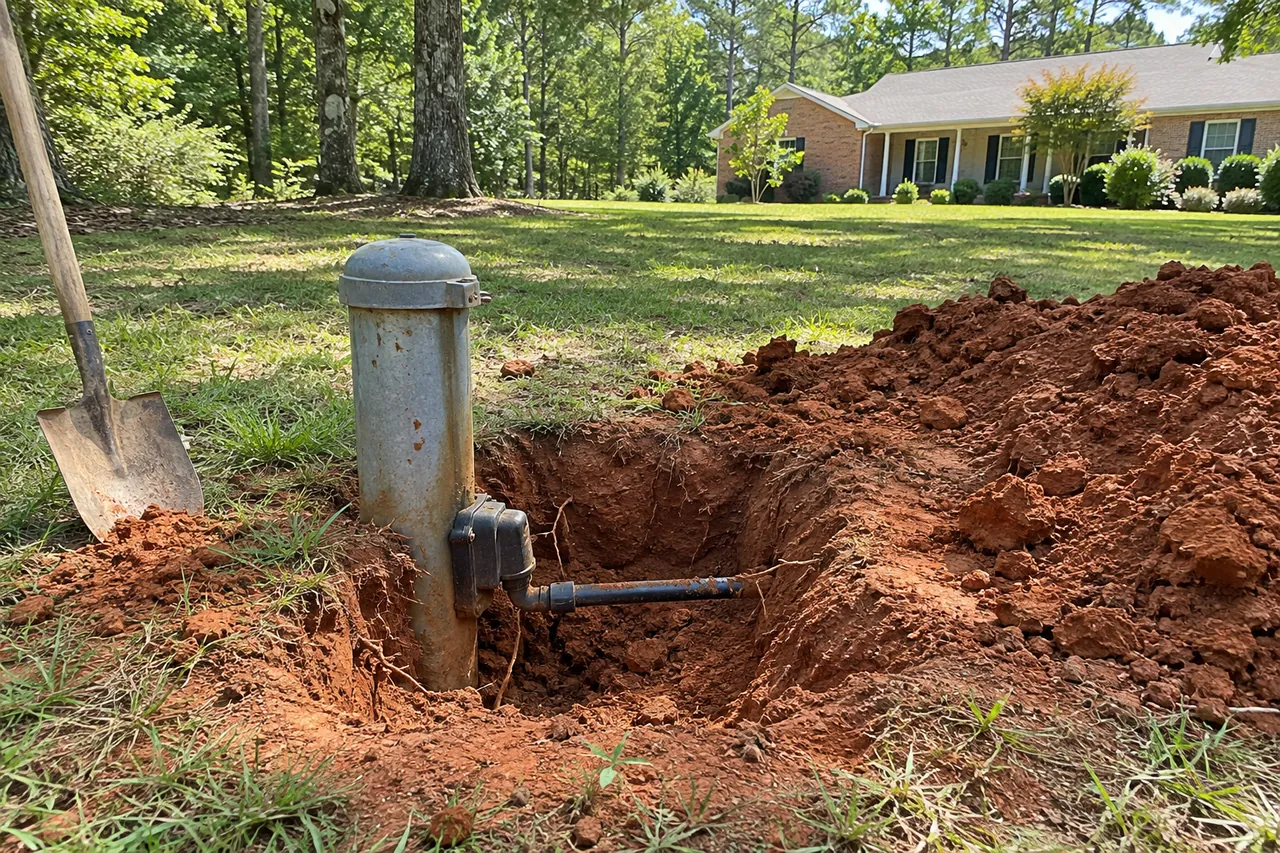
How water gets from the well to your faucet
If the whole pump sits down inside a drilled well, it's a submersible: pump and motor in a single unit, about 3½ inches across and 2 to 3 feet long, hung below the water level inside the casing. That description comes from University of Nebraska–Lincoln Extension's guide to well distribution systems (G2152). Other homes use a jet pump, which sits above ground in a basement or well house. A shallow-well jet lifts water from less than 25 feet down; a deep-well jet, with a jet assembly inside the well, reaches water 25 to 250 feet down.
Water leaves a drilled well through a pitless adapter, a fitting on the casing below the frost line that feeds a buried line to the house. There it fills a pressure tank, which holds water under air pressure so the pump doesn't start every time a tap opens. A pressure switch at or near the tank starts the pump when pressure falls to its low setting and stops it at the high one. Some submersible motors also have a control box above ground with starting parts such as a start capacitor. Any of these can be the part that failed. Pressure tanks and switches goes deeper on the tank side.
Signs the system needs repair
- No water, or a toilet tank that won't refill.
- Pressure that's low, or that drops off suddenly.
- Faucets that spit or sputter, or air in the lines.
- The pump switching on and off rapidly (short cycling), or quick clicking at the tank.
- A pump that runs and runs without shutting off.
- Dirty, cloudy, sandy or silty water.
- An electric bill that jumps for no obvious reason.
- Grinding, humming or clicking noises.
Those come from the warning-sign lists in HomeAdvisor's, This Old House's and HomeServe's well pump guides. Several point past the pump itself. UNL Extension explains that a tank short on air makes the pump run nearly every time water is used, and NEHA notes that a system losing pressure can start the pump when nobody is using water.
What to check before you call
Keep it to these, in this order:
- See whether the power is out.
- Check the well pump's breaker. One reset is the limit; a second trip means leave it off.
- Read the pressure gauge at the tank and note the number.
- Look for a visible leak at the tank, at exposed pipes, and in the yard between the well and the house.
- Call, and pass along what you found.
Leave the pressure switch cover closed and the wiring alone. The Virginia Department of Health warns well owners not to adjust pumps themselves because of "significant injury hazards, including electrical shock and loss of limbs." No water from your well walks through each check in more detail.
What a repair visit covers
The contractor has to find the failed part before anything gets replaced. Several suspects can be checked and swapped from above ground: the pressure switch, the pressure tank, the control box and its start capacitor, and the breaker. HomeAdvisor prices each as its own repair. On a jet pump the pump itself is above ground too, and UNL notes that an air leak in the suction pipe or a water leak in the drop pipe makes it lose its prime; the suction line relies on a check valve to hold it.
A submersible is a bigger job. UNL says it has to be pulled from the well for repair, which means lifting the pump, its drop pipe and its wire up through the casing. Because that reaches inside the casing, Virginia's well regulations call for the well to be disinfected afterward (see the rules below). Once the pump is out of the hole, the repair-or-replace question usually comes up.
Repair or replace?
Age is the first clue. HomeAdvisor puts a typical well pump at about 15 years, adding that low-quality pumps under heavy use can fail in as few as 8. HomeServe's range is 8 to 15 years, with submersibles often outlasting jet pumps, and American Home Shield gives an average of 14. A pump installed in 2012 turns 14 in 2026, right at that average.
Questions worth asking: which part failed, and how did you test it? What does the repair cost compared with a new pump? If the pump has to come out of the well anyway, would replacing it now save paying for a second pull later? The replacement guide covers pump types and sizing.
Virginia rules that apply to repairs
- No VDH well permit. A permit from VDH is required before a private well is built, altered, deepened or abandoned, yet 12VAC5-630-220 states that "the replacement of a well pump" shall not be considered a well alteration. The same goes for swapping a well cap or seal for an equivalent one.
- Disinfection. Under 12VAC5-630-410, maintenance or other work requiring access to the inside of a completed well's casing is to be followed by disinfection per 12VAC5-630-430. That section allows two methods: hold 100 mg/L of chlorine in the well for 24 hours, or deliver at least 100 mg/L through the well and reach 1,000 "contact units," which it counts as mg/L times hours (its examples are 50 mg/L for 20 hours and 200 mg/L for 5 hours).
- Building permits. The Uniform Statewide Building Code (13VAC5-63-80, Section 108.2) exempts replacing well pumps as long as the water supply and distribution systems stay unaltered. A new pressure switch, tank or wiring isn't listed there, so check with your county building office.
- A sealed wellhead. The well regulations allow no open wells or wellheads, and drinking-water wells need a mechanical seal: a sanitary well seal or a pitless adapter.
More detail, including setbacks and new-well permits, is in Virginia well rules.
What repairs cost
HomeAdvisor's national well pump repair figures (updated October 2022) give an average of $970 and a typical range of $373 to $1,619, with $100 and $3,000 as the extremes. Its Chesterfield, VA page, which carries no date, shows an average of $830, with jobs ranging from $200 to $2,080. HomeServe's guide (updated October 2026) puts minor repairs at $100 to $500 and labor at $45 to $150 an hour.
Common repair items, installed (HomeAdvisor, national, 2022)
- Pressure switch
- $120–$180 ($20–$40 for the part alone)
- Control box
- $200–$500
- Motor start capacitor
- $100–$150
- Pitless adapter
- $150–$450
- Foot valve
- $150–$300
- Pressure tank
- About $500–$1,000
- House call
- $100–$150, or up to $300 with flat-rate pricing
HomeAdvisor adds that after-hours and weekend rates usually run about double. All of these are published ranges rather than Powhatan quotes; what you'll actually pay is the price the contractor gives after looking at your system. The cost guide has the full breakdown.
Before you hire
Contractors are responsible for their own permits, pricing and warranties. Well and pump companies install the well system, including the pump and tank with their pipe and wire, and plumbing and electrical contractors may also install well pumps and tanks. Who fixes well pumps lists questions to ask.
Repair questions
Can a submersible pump be fixed without pulling it out of the well?
Not the pump itself; UNL Extension says a submersible must be pulled for repair. The switch, tank, control box and breaker can all be reached from above ground, though, so those get checked before anyone decides the pump has to come up.
Does a well pump repair need a permit?
Not from VDH, and a straight pump replacement is exempt from a building permit under the statewide code. Tank, switch and wiring jobs fall outside that exemption's wording; your county building office can say whether they need a permit.
Why would the pump run but no water come out?
The sources name a few possibilities: a jet pump that has lost its prime through an air leak or a leaking valve (UNL), a burst pipe (NEHA), or a water level that has dropped below the pump, which Virginia Tech says becomes more likely in a drought. Each calls for a different fix, which is why the diagnosis comes first.
Will the water be safe to drink after the repair?
If the work reached inside the casing, Virginia's rules call for chlorine disinfection, and NEHA's advice is a coliform and nitrate test before you rely on the water again. Ask the contractor how and when the well will be disinfected.
Does a repair cost more on a weekend?
Usually. HomeAdvisor says after-hours and weekend rates typically run about double the regular rate, so ask about it when you schedule.
How this site helps
Send a request or call, and we'll introduce you to one independent local well and pump contractor; they look at your system and price the repair themselves.
Related pages
Sources
- University of Nebraska–Lincoln Extension, Private Drinking Water Wells: The Distribution System (G2152), July 2012
- Virginia private well regulations: 12VAC5-630-220, 12VAC5-630-410, 12VAC5-630-430
- Uniform Statewide Building Code, 13VAC5-63-80 (Section 108)
- VDH, Responding to Emergencies Affecting Your Private Well, updated July 23, 2026
- NEHA and the Private Water Network, Power Outages fact sheet
- HomeAdvisor, well pump repair cost, updated Oct. 17, 2022, and Chesterfield, VA well pump repair, undated
- HomeServe, well pump cost guide, updated Oct. 28, 2026; This Old House, well pump cost guide, updated Mar. 5, 2026; American Home Shield, cost to replace a well pump, Feb. 6, 2026
- Virginia Tech, Groundwater remains low despite recent rain, Aug. 10, 2026
Need someone to find what failed?
One independent local well and pump contractor, one quote.