
Well Pressure Tanks, Pressure Switches & Constant-Pressure Systems
On a Powhatan County well, the pressure tank and pressure switch decide how the water feels at your tap and how hard the pump has to work. If the pump is short cycling, the pressure keeps swinging, or someone has suggested a new tank or a constant-pressure controller, this page explains how each part works, how tanks are sized, the settings that matter, what Virginia's rules say about tank and switch work, and what it costs.
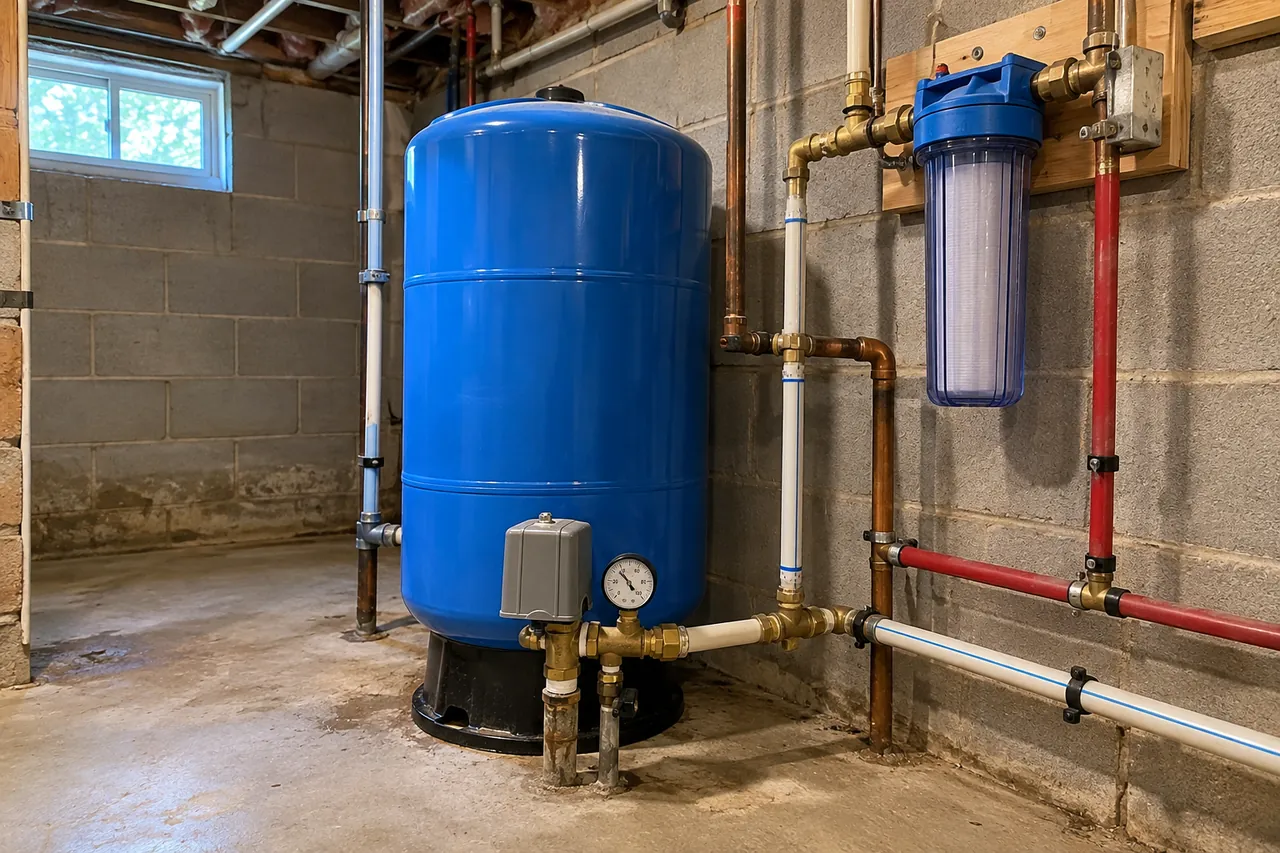
What the pressure tank does
University of Nebraska–Lincoln Extension's publication on private well distribution systems (G2152) gives the tank three jobs. It stores water and delivers it under pressure while the pump is off. It cuts down how often the pump starts and stops, which prolongs the pump's life. And it holds a reserve for moments of heavy use. As the pump fills the tank, the air inside compresses and the pressure climbs until the switch shuts the pump off; UNL says that shutoff is typically set somewhere from 40 to 60 psi, with the pump restarting around 20 to 40.
Three kinds of tank
- Bladder or diaphragm. Common since about 1970 and often paired with submersible pumps. The water sits inside a butyl rubber or PVC bladder, kept apart from the air, so no air-control device is needed. These tanks come from the factory charged to about 20 psi, adjustable through an air valve near the top.
- Galvanized steel. The usual tank until about 1970, used with jet, centrifugal and piston pumps. Air and water are in direct contact, so the water slowly absorbs the air and the tank needs an air-volume control. It generally has to sit within 4 feet of the pump. With too little air it becomes waterlogged; with too much it becomes air-bound.
- Steel with a floating wafer. A wafer separates air from water, nearly doubling the usable storage of a plain galvanized tank, but the tank has to be recharged with air every 6 to 12 months.
Drawdown and sizing
Drawdown is the water a tank hands out between the pump shutting off and starting again, and it's only a fraction of the tank's size. UNL's table shows how much the tank type matters:
Tanks with the same usable water per cycle (UNL Extension)
- 30-gallon galvanized
- Same as a 14-gallon bladder or precharged wafer tank: 5.1 gallons at 20–40 psi, 4.3 at 30–50, 3.7 at 40–60.
- 42-gallon galvanized
- Same as a 20-gallon bladder or precharged wafer tank: 6.5 gallons at 20–40 psi, 5.5 at 30–50, 5 at 40–60.
- 82-gallon galvanized
- Same as a 32-gallon bladder or precharged wafer tank: 12 gallons at 20–40 psi, 10 at 30–50, 8.5 at 40–60.
- 120-gallon galvanized
- Same as a 45-gallon bladder or precharged wafer tank: 18 gallons at 20–40 psi, 15 at 30–50, 12 at 40–60.
For sizing, UNL multiplies the pump's flow in gallons per minute by 4 for a bladder tank and by 10 for galvanized. A 9 gpm pump therefore calls for about a 36-gallon bladder tank or a 90-gallon galvanized one. Above 25 gpm, UNL says to ask the pump supplier, and two smaller tanks side by side may cost less than one large one. On pipe runs longer than 500 feet, a second tank can go near the far end of the line.
Low-yield wells need more thought. UNL cautions that a bladder tank leaves little water at pump-on pressure and may not suit a low-yield well unless a second tank is added. That's relevant here: in Goochland's review of county well records, 83% of drilled wells yielded 10 gpm or less.
The pressure switch
The switch, usually mounted at or near the tank, turns the pump on at its low setting (cut-in) and off at its high setting (cut-out). The manufacturer or installer sets it, and it can usually be adjusted afterward. UNL names 20/40, 30/50 and 40/60 psi as common ranges.
The switch and the tank's air charge have to agree. UNL says manufacturers recommend charging a bladder tank to about 2 psi below the cut-in pressure, which works out to:
- 20/40 switch: about 18 psi
- 30/50 switch: about 28 psi
- 40/60 switch: about 38 psi
A switch can also fail outright. Penn State Extension's drought fact sheet lists "a malfunctioning electrical switch at the pressure tank" among the reasons a house loses water. HomeAdvisor prices a replacement at $120 to $180 installed, with the part itself $20 to $40. The switch controls power to the pump, so keep its cover on; VDH tells well owners not to adjust pumps themselves, citing shock and serious injury hazards.
Constant-pressure systems
A constant-pressure system swaps the switch for a controller, a variable-frequency drive, that changes the pump motor's speed to hold one pressure rather than swinging between two. A 2001 article in the trade magazine The Driller listed the advantages as a soft start, less on-off wear and a much smaller tank (2 gallons in its example). UNL likewise says VFD-controlled submersible systems typically need only a 1- to 2-gallon precharged tank.
Two cautions. The Driller notes that these electronics can hold several hundred volts after shutdown, and tells technicians to wait 15 minutes before working on them. And they cost more: American Home Shield (February 2026) puts constant-pressure systems at $2,000 to $5,000. The technical sources here are older, so ask the contractor how a controller would work with your particular pump and well.
Signs the tank or switch needs attention
- Short cycling: the pump turning on and off rapidly, sometimes with fast clicking at the tank (HomeAdvisor, This Old House).
- The pump starting nearly every time a tap opens, which UNL ties to a waterlogged tank with little air left to compress.
- Low pressure, or pressure that drops off suddenly (HomeAdvisor, HomeServe).
- No water at all, when the switch has failed (Penn State Extension).
Cost guides publish lifespans for pumps, but we found no credible source giving one for pressure tanks or switches, so go by how the system behaves rather than by age. Low pressure and short cycling explains how to read the gauge safely.
Permits and rules for tank and switch work
VDH's permit rule (12VAC5-630-220) covers building, altering, deepening and abandoning wells, and is silent on pressure tanks; a tank sits outside the well. The disinfection requirement in 12VAC5-630-410 is triggered by work requiring access to the inside of the casing; by that wording, a tank-only job doesn't trigger it, while pulling a pump does.
The building code is less clear-cut. The statewide code's permit exemption (13VAC5-63-80) names "plumbing fixtures and well pumps," not tanks, switches, new circuits or constant-pressure controller wiring, so call your county building office before that work is done. Powhatan's residential mechanical, plumbing and electrical permit form doesn't mention well equipment beyond a public-or-private-well checkbox, and Goochland's list of permit types has no well pump or pressure tank item, which leaves a call to the office as the way to find out.
What tank and switch work costs
National ranges, by source
- Pressure tank replacement
- About $500–$1,000 (HomeAdvisor repair guide, 2022)
- Tank and switch together
- $300–$500 (HomeAdvisor well drilling guide; the two HomeAdvisor pages disagree)
- Pressure switch
- $120–$180 installed; $20–$40 for the part (HomeAdvisor, 2022)
- Constant-pressure system
- $2,000–$5,000 (American Home Shield, Feb. 2026)
- Service call
- $100–$150, up to $300 flat-rate (HomeAdvisor, 2022)
Tank size and type, whether the switch and gauge are replaced along with it, and any piping changes all affect the price. These are national figures, not Powhatan quotes. The cost guide has the rest.
Tank and switch questions
How big a pressure tank does a house need?
UNL's rule is the pump's flow in gallons per minute times 4 for a bladder tank, or times 10 for galvanized. A 7 gpm pump works out to about 28 gallons of bladder tank; a 10 gpm pump, about 40.
What should the air pressure in a bladder tank be?
About 2 psi below the switch's cut-in pressure, per UNL: 28 psi for a 30/50 switch, 38 for a 40/60. New tanks arrive at about 20 psi, so on a 30/50 or 40/60 switch the charge has to be raised at installation. Ask the contractor to check it if the pump is cycling.
Does replacing a pressure tank need a permit in Virginia?
Not from VDH, whose permit rule covers the well itself. The statewide building-code exemption names well pumps but not tanks, so ask your county building office. Contractors are responsible for pulling any permits their work needs.
Why does an old galvanized tank keep losing its air?
Because air and water touch inside it, and UNL explains that the water absorbs the air over time. That's what the tank's air-volume control is for. When the control isn't keeping up, the tank waterlogs and the pump starts with nearly every draw.
Can a different tank setup help a low-yield well?
It can be part of the answer. UNL notes that a single bladder tank may not suit a low-yield well unless a second tank is added. Whether that's the right move depends on your well's yield, which a contractor can measure.
How this site helps
Reach us by phone or the request form, and it goes to one independent local well and pump contractor, who can look over your tank and controls and quote the work.
Related pages
Sources
- University of Nebraska–Lincoln Extension, Private Drinking Water Wells: The Distribution System (G2152), July 2012
- The Driller, Constant Pressure Is the Name of the Game, Mar. 5, 2001
- Penn State Extension, Managing Your Well During a Drought (Water Facts #7), 2005
- Goochland County, Evaluation of Existing Water Supply
- Virginia private well regulations, 12VAC5-630-220 and 12VAC5-630-410; Uniform Statewide Building Code, 13VAC5-63-80
- Powhatan County, Residential Mechanical/Plumbing/Electrical Permit; Goochland County, List of Permit and Plan Types
- VDH, Responding to Emergencies Affecting Your Private Well, updated July 23, 2026
- HomeAdvisor, well pump repair cost, updated Oct. 17, 2022, and well drilling cost; This Old House, well pump cost guide, updated Mar. 5, 2026; HomeServe, well pump cost guide, updated Oct. 28, 2026; American Home Shield, cost to replace a well pump, Feb. 6, 2026
Tank or switch giving you trouble?
Your request goes to one independent local well and pump contractor.