
Low Water Pressure, Sputtering & Short Cycling on a Well
When the shower weakens on a Powhatan County well, the faucets spit air, or you hear the pump clicking on and off every few seconds, the system is telling you something about its pressure. This page explains how pressure works on a private well, how to read the gauge on your tank, the common causes of low pressure, sputtering and short cycling, what a well pump contractor will look at, and what the fixes cost.
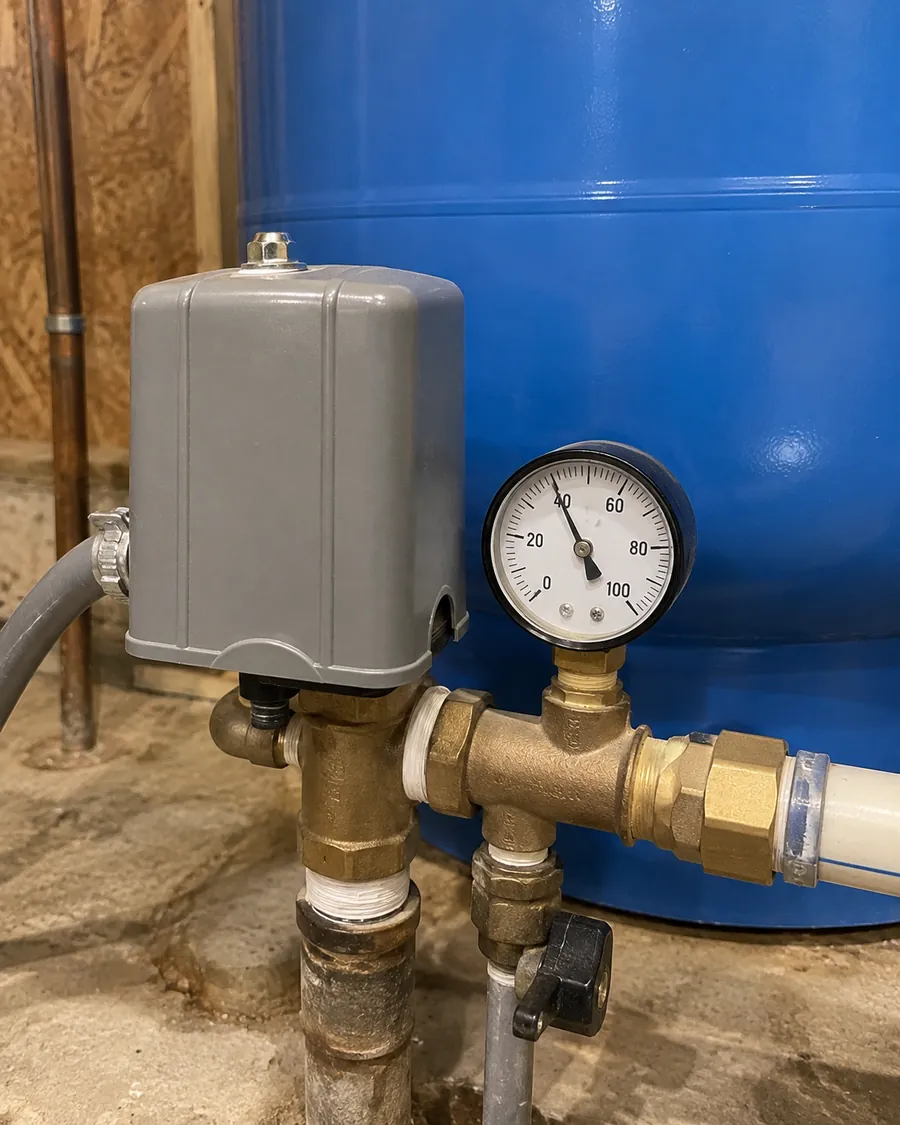
How pressure works on a well
Your faucets don't draw straight from the pump. The pump fills a pressure tank, squeezing a cushion of air until a pressure switch shuts the pump off. As you use water, that air pushes it out and the pressure falls until the switch starts the pump again. University of Nebraska–Lincoln Extension's well system guide (G2152) gives 20/40, 30/50 and 40/60 psi as common switch ranges: the first number is where the pump starts, the second where it stops.
So pressure on a well always swings. On a 30/50 switch, the pressure at your tap slides from 50 down to 30 and back up with every pump cycle. UNL notes that almost all fixtures need at least 10 psi, but water treatment units, softeners, clothes washers and dishwashers need at least 30. With a 20/40 switch, the bottom of every cycle sits 10 psi under that line.
Reading your gauge
The gauge is usually on or next to the pressure tank. Looking at it is safe; touching the switch beside it isn't. Four readings give a contractor a lot to work with:
- The reading with no water running.
- With a faucet or two open, the point where the needle bottoms out and starts climbing again. That's roughly where the pump starts.
- With the faucets closed again, the point where it stops climbing. That's roughly where the pump shuts off.
- With everything off for a while, whether the reading holds or slowly sinks.
NEHA's well-owner guidance says to check whether the system is holding pressure, and warns that when it's leaking pressure away, the pump may switch on with every tap closed. Write the numbers down and pass them along when you call.
Common causes of low pressure
- A worn pump. Low or suddenly dropping pressure appears on the warning-sign lists in HomeAdvisor's and HomeServe's well pump guides.
- A falling water level. Virginia Tech's August 2026 drought report connects sputtering and weak pressure with water dropping below the pump, and DEQ had Powhatan, Goochland, Amelia and Cumberland under a drought warning as of October 2, 2026.
- A clogged well. Penn State Extension notes that iron bacteria and sediment can clog a well and severely restrict flow.
- A leak. NEHA says low pressure can come from a burst pipe somewhere in the system.
- The house plumbing. UNL points out that a poorly designed or aging plumbing system can leave fixtures short of water even when the well and pump are fine, and suggests a plumber for that part of the system.
Sputtering and air in the lines
Spitting faucets mean air is getting into the water somewhere between the well and the tap. NEHA treats air hissing out of a faucet between bursts of water as a sign the system may have lost pressure. In a drought, Virginia Tech says sputtering can mean the water level has fallen to the pump. A jet pump has its own version: UNL explains that it loses its prime when air leaks into the suction pipe or water leaks out of the drop pipe, and that a check valve on the suction line is what keeps the prime. Cloudy, sandy or silty water showing up alongside the sputtering is another item on cost guides' lists of pump trouble signs.
Short cycling: a pump that won't stay off
Short cycling is the pump starting and stopping rapidly, sometimes with quick clicking at the tank; HomeAdvisor and This Old House both list it as a warning sign. It matters because limiting pump starts is the tank's whole job, and UNL says that reduction is what prolongs pump life.
One cause UNL describes is a tank short on air. In a galvanized tank, the water gradually absorbs the air; once the tank is waterlogged there's little air left to compress, and the pump runs nearly every time water is used. Bladder tanks keep air and water apart but still depend on the right air charge, which UNL puts at about 2 psi below the pump's cut-in pressure. That's 28 psi on a 30/50 switch and 38 psi on a 40/60. Bladder tanks ship precharged at about 20 psi, so one left at its factory charge on a 40/60 switch is 18 psi under that target.
Leave the switch and the tank's air valve to the contractor, in line with VDH's warning against adjusting well pumps yourself. A pump that runs constantly is a related symptom on HomeAdvisor's list, and This Old House and HomeServe both mention a sudden jump in the electric bill as a sign of pump trouble.
What a contractor checks, and what fixes cost
On a pressure complaint, a contractor will typically compare your gauge readings with the switch settings, check the tank's air charge, see what the pump is delivering, and look for leaks before recommending a part. Published prices for the usual fixes:
National ranges, by source
- Pressure switch
- $120–$180 installed, $20–$40 for the part (HomeAdvisor, 2022)
- Pressure tank
- About $500–$1,000 to replace (HomeAdvisor, 2022). A separate HomeAdvisor page puts a tank and switch together at $300–$500.
- Foot valve (jet pumps)
- $150–$300 (HomeAdvisor, 2022)
- Pump replacement
- $900–$2,500 typical (This Old House, updated March 2026)
- Constant-pressure system
- $2,000–$5,000 (American Home Shield, Feb. 2026)
On permits: the statewide building code's exemption covers replacing well pumps, but pressure tanks, switches and wiring aren't named in it, so ask your county building office whether that work needs one. VDH's well permit rule doesn't mention tanks, which sit outside the well. Virginia well rules and the cost guide have more.
Pressure questions
What should a well pressure gauge read?
Somewhere between your switch's two settings, such as 30 and 50 psi on a 30/50 switch. A reading that sinks with every tap closed, or one that never climbs to the shutoff number, is worth reporting.
Why does the well pump click on and off every few seconds?
That's short cycling. A tank short on air is one cause UNL describes: a waterlogged tank holds so little air that the pump runs nearly every time water is used. A failing switch or a leak are other places a contractor will look.
Is it safe to adjust the pressure switch yourself?
No. VDH's guidance is that owners shouldn't make their own pump adjustments, given the risk of shock and serious injury. A new switch setting also has to match the tank's air charge, which UNL puts about 2 psi below the cut-in pressure.
Is low pressure always a well problem?
No. UNL notes that old or poorly designed household plumbing can starve fixtures even when the well and pump are fine. If the gauge at the tank looks normal but one bathroom is weak, the problem may be inside the house.
Will a constant-pressure system fix low pressure?
It removes the swing between two settings by holding one pressure, as The Driller describes these systems. It can't add water the well doesn't have or fix a leak, so the cause needs finding first. Pressure tanks and switches explains how they work.
How this site helps
Describe what the gauge and faucets are doing, and we'll hand that to one independent local well and pump contractor, who quotes the fix directly.
Related pages
Sources
- University of Nebraska–Lincoln Extension, Private Drinking Water Wells: The Distribution System (G2152), July 2012
- NEHA and the Private Water Network, Power Outages fact sheet
- Virginia Tech, Groundwater remains low despite recent rain, Aug. 10, 2026; Virginia DEQ, drought status update, Oct. 2, 2026
- Penn State Extension, Managing Your Well During a Drought (Water Facts #7), 2005
- VDH, Responding to Emergencies Affecting Your Private Well, updated July 23, 2026
- Uniform Statewide Building Code, 13VAC5-63-80; private well regulations, 12VAC5-630-220
- The Driller, Constant Pressure Is the Name of the Game, Mar. 5, 2001
- HomeAdvisor, well pump repair cost, updated Oct. 17, 2022, and well drilling cost; This Old House, well pump cost guide, updated Mar. 5, 2026; HomeServe, well pump cost guide, updated Oct. 28, 2026; American Home Shield, cost to replace a well pump, Feb. 6, 2026
Pressure still acting up?
Send us the gauge readings and we'll pass them to one independent local well and pump contractor.